


Support and IUCN:
The Intergovernmental Panel on Climate Change (IPCC) claims that North America is supposed to warm between 3.6-18º F (2-10ºC) depending on the region. The U.S. knows Arctic temperature will increase and that this will affect the U.S. The U.S. Climate Change Science Program (CCSP) has initiated 21 separate analyses to be completed over the next 2 to 3 years. There are going to be changes in plant and animal species. Everyone can assist and stop climate change. Those who reduce energy consumption can make you save money. Helping the environment can help oneself and also future generation’s health and wellness. The reduction of greenhouse gases can assist everyone especially our children and theirs to come.
The International Union for Conservation of Nature (IUCN) was founded in Geneva, Switzerland and now has over 60 buildings throughout the world. IUCN is a major conservation union that helps the world find solutions for significant environmental and developmental problems. The IUCN supports scientific research, manages field work, non government organizations, United Nations organizations, and large and local companies and policies and ethical acts that will help benefit the environment.
IUCN is the world’s oldest environmental network. It is a democratic network with over 1,000 government organizations, 11,000 scientist volunteers that are found in countries all over the world. Their plan is to conserve nature. They want to encourage countries throughout the world to support their environment and that their use of natural resources is used moderately.
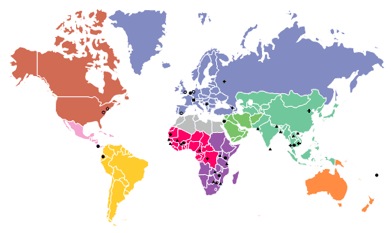
Above are locations of IUCN offices found in North America, South America, Europe, Asia, Australia and Africa.
IUCN develops conservation science in mostly species and ecosystems which humans tend to threaten. They pass policies to help these threatened species and ecosystems be better protected by humans. Nature provides us with everything that is pure and beneficial to our bodies. It is necessary that humans play their part in trying to protect nature for themselves and for the future of the Earth.
IUCN was founded October 1948. Thus for over 60 years, this organization has been a leading cause for the conservation of nature. Their main objective is to conserve the environment.
There are 12 major programmes in IUCN that work across 10 regions with 6 commissions along with member organizations to help climate change. Climate change is said to be unstoppable because it is the nature of the Earth to evolve. IUCN wants to help prepare animals and ecosystems prepare for the effects of climate change.
IUCN knows that climate change is affecting marine ecosystems throughout the world. They have said that melting sea caps and shifting species relate to one another because species are having more difficult times finding food where the sea caps are melting. The melting sea caps are effecting marine species, and eventually humans will also be effected by these problems.
Scientists have calculated that oceans are becoming more acidic over time. Acidity in the oceans has increased 30% in the past 200 years, and will continue to increase yearly. The amount of acidity in the water has had a deep impact on marine wildlife and ecosystems. Higher acidity in the oceans has also caused problems with climate regulation.
Sea ice is also melting. In the past decade scientists have calculated that 35% of the Arctic sea ice has decreased in the summer months while it has decreased 15% in the winter months. This problem has made it more difficult for animals to find homes. The melting of Arctic sea ice is affecting habitats of species and ecosystems.
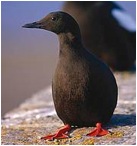
Sea birds are being affected by the increasing warming climate.
Climate change has also caused a difference in plankton, fish distribution and species in the Arctic region. It is believed that this lack of food in the arctic region will cause sea bird populations to decline. It is also believed that non native species will eventually adapt to regions that are not their habitats, due to climate change because these regions will be getting warmer. Non native species will cause problems in fishing and over population with native species.
Coastal regions will face many problems in the future such as erosion and overpopulation of species. It is important that IUCN and other organizations help coastal regions prepare for the impact of climate change.